9 Funny Australian Animals Kids Love (and the Weird Facts Behind Them)
Kids can’t get enough of funny Australian animals, and no wonder. We’ve got a bird that laughs, a mammal that lays eggs, one that does cube-shaped poo and another that glows under UV light.
Funny Australian animals are also the reason Flipsy exists. Our characters started as the animals we see around our Hunter Valley workshop: the magpie on the fence, the kookaburra on the clothesline and the ibis eyeing off everyone’s lunch. Here are nine favourites, with the facts kids remember and repeat at the dinner table.
The line-up:
1. The laughing kookaburra: the bird that sounds like it’s in on a joke
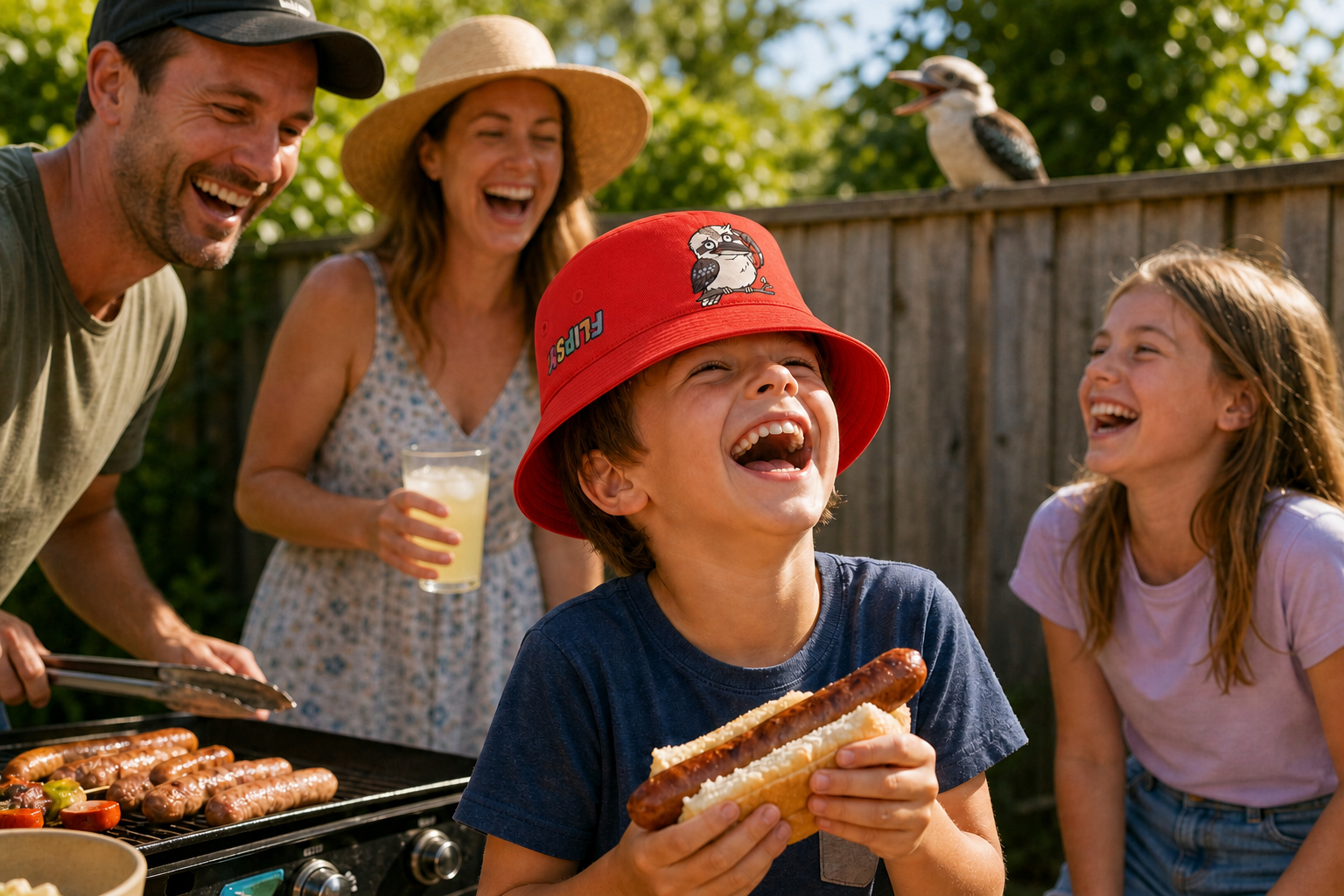
The kookaburra’s “laugh” is actually a territorial call. A family group joins in together, especially at dawn and dusk, to tell the neighbours “this patch is ours”. That’s why bush folk called it the bushman’s alarm clock.
- It’s the world’s biggest kingfisher, yet it hardly ever eats fish. Lizards, insects and even snakes are on the menu.
- Families stick together, and older siblings help raise the new chicks.
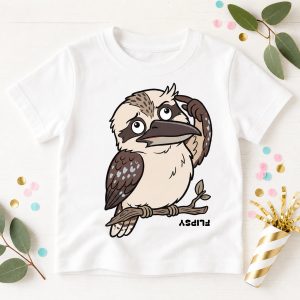
Our kookaburra is Chuckles, who laughs at absolutely everything. He just never knows what at. Kids love his Ha Ha Ha! tee and the Belly Laugh tee.
2. The Australian white ibis: Australia’s most famous bin chicken
Ask an Aussie kid for funny Australian animals and the “bin chicken” will come up fast. The Australian white ibis is a native wetland bird. Over the past few decades, many have moved into towns and cities as inland wetlands dried out, and found picnic leftovers along the way.
- That long, curved beak is built for probing mud for yabbies, worms and insects.
- They nest in big noisy colonies, often in trees on islands in city parks.
- Despite the nickname, they’re a protected native species with a pretty impressive survival story.
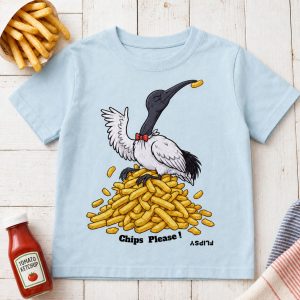
Our ibis is Binny, who wears a red bow tie and loves two things: chips and treasure. Meet her on the Chips Please tee and the Finders Keepers tee.
3. The Australian magpie: a mimic with a memory
Magpies have one of the most beautiful songs in the bush. They can also mimic other sounds, including dogs barking and even human voices. They’re clever too: magpies can recognise individual human faces.
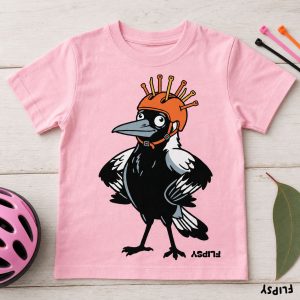
That memory is why a magpie that swoops you once often swoops you again. Our guide to magpie swooping season has the safety tips for kids. Our own magpie, Swoop, is scared of swooping season himself and wears a cable-tie helmet just in case.
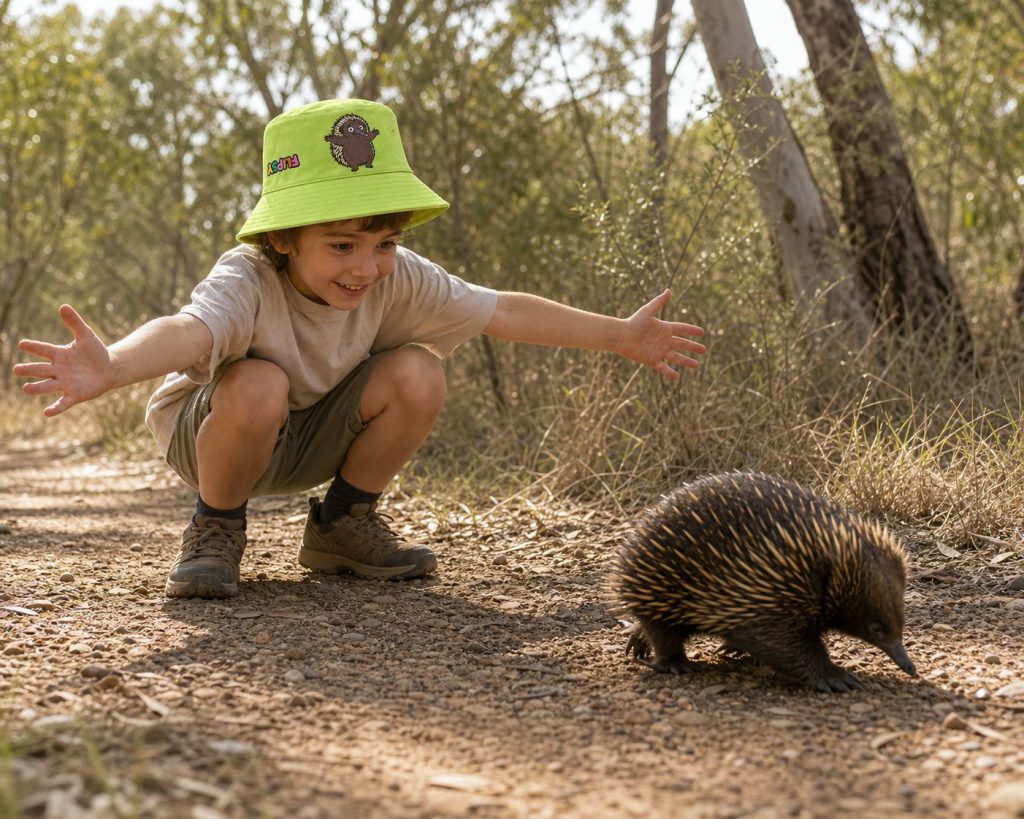
4. The short-beaked echidna: a spiky mammal that lays eggs
Echidnas are one of only a handful of mammals in the world that lay eggs. These egg-layers are called monotremes. Their babies are called puggles, which might be the best word in the English language.
- Those spines are actually special hairs.
- Echidnas have no teeth. They catch ants and termites with a long, sticky tongue.
- Their snout can sense the tiny electrical signals given off by bugs underground.
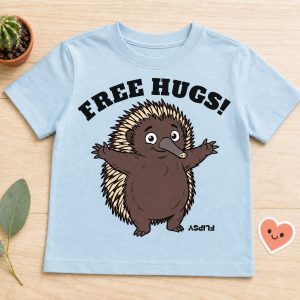
Our echidna, Spike, loves hugs more than anything, which is a problem when you’re covered in spines. He stars on the Free Hugs tee and Cuddle Expert.
5. The quokka: the animal that always looks like it’s smiling
Quokkas live mostly on Rottnest Island off Perth, plus a few pockets of south-west WA. Their face is shaped so they look like they’re grinning, which is why they’re called the happiest animal in the world.
- Rottnest Island got its name from a Dutch explorer who thought quokkas were giant rats. “Rotte nest” means rat’s nest.
- They’re wild animals. Touching or feeding them is against the rules on Rottnest, and the fines are hefty.
Our mascot Flipsy is an upside-down quokka with a rainbow tail. Flipsy hides somewhere on every tee, so check yours.
6. The wombat: famous for cube-shaped poo
Yes, really. Wombats make cube-shaped poo, and they stack it on rocks and logs to mark their territory. Square edges mean it doesn’t roll away.
Wombats also have a backwards-facing pouch, so the joey doesn’t get a face full of dirt while mum digs.
7. The platypus: it glows under UV light
As if a duck-billed, egg-laying, beaver-tailed mammal wasn’t strange enough, scientists found in 2020 that platypus fur glows a blue-green colour under ultraviolet light. Males also have a venomous spur on their back legs, so they’re best admired from a distance.
8. The koala: fingerprints just like ours
Koalas have fingerprints so similar to human ones that they’re hard to tell apart, even under a microscope. They also sleep around 18 to 20 hours a day, because gum leaves don’t give them much energy. And no, they’re not bears.
9. The superb lyrebird: the bush’s best impressionist
Lyrebirds copy the calls of other birds so well they can fool the birds themselves. Some have even been recorded copying human sounds like camera shutters and chainsaws. The male’s tail feathers fan out into the shape of a lyre, an old stringed instrument, and that’s how the bird got its name.
Why kids love funny Australian animals
Funny animals make facts stick. A kid who learns that wombats do square poo will remember it forever, and will then wonder what else they don’t know. We think that curiosity is worth feeding.
It’s also why every Flipsy character has one small, very relatable worry. A magpie who’s scared of swooping season is funny, and it also tells kids it’s normal to be scared of things. Find them all on the Meet the Gang page, wear them on the Australian animal tees or stick them on everything with a sticker pack.
-

Chuckles
Price range: $35.00 through $39.00 Select options This product has multiple variants. The options may be chosen on the product page -
Binny: Chips Please
Price range: $35.00 through $39.00 Select options This product has multiple variants. The options may be chosen on the product page -
Spike
Price range: $35.00 through $39.00 Select options This product has multiple variants. The options may be chosen on the product page -
Swoop
Price range: $35.00 through $39.00 Select options This product has multiple variants. The options may be chosen on the product page
Funny Australian animals: FAQs
What is the funniest Australian animal?
The laughing kookaburra usually wins with kids, because its call sounds just like someone cracking up. The quokka, with its permanent smile, and the wombat, with its cube-shaped poo, are close behind.
Why is the ibis called a bin chicken?
Australian white ibis moved into towns and cities as inland wetlands dried out, and some learned to find food in bins and picnic leftovers. The nickname stuck, but they’re a protected native bird.
Why do kookaburras laugh?
The laugh is a territorial call. Kookaburra families call together, mostly at dawn and dusk, to let other kookaburras know whose patch it is.
Can you touch a quokka?
No. Quokkas are wild animals, and touching or feeding them on Rottnest Island is against the rules and can lead to a fine. Selfies from a respectful distance are fine.
Is an echidna a mammal?
Yes. The echidna is a monotreme, a mammal that lays eggs. The platypus is the only other kind of monotreme, and baby echidnas are called puggles.